
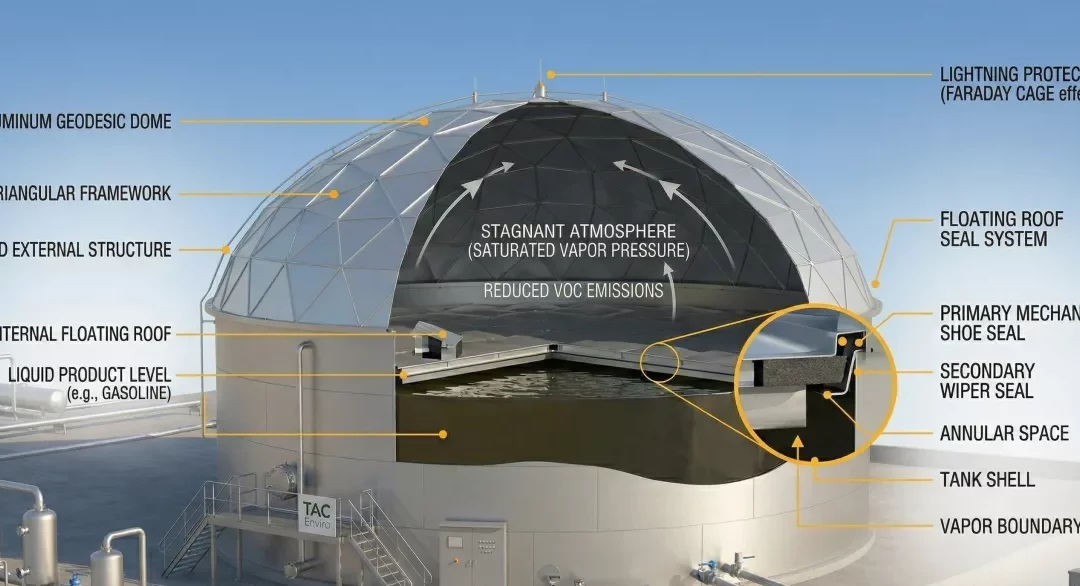
In the context of modern industrial storage, especially for volatile liquids like petroleum and chemicals, optimizing the integrity of the containment vessel is paramount. The dual challenge is to minimize product loss through evaporation and prevent environmental contamination from Volatile Organic Compounds (VOCs). Meeting these objectives requires a multifaceted engineering approach. A central component of this strategy is the optimization of the floating roof system, where the synergy between advanced floating roof seal technology and structural covers, specifically aluminum geodesic domes, creates a superior storage environment.
The Role of Floating Roof Seals in Atmospheric Protection
Bulk liquid storage tanks utilize floating roofs as a dynamic barrier against vapor emission. A floating roof is designed to rise and fall with the liquid level, effectively eliminating the vapor space above the product. However, the performance of the floating roof hinges entirely on the efficacy of the floating roof seal system. This system bridges the annular space, or the gap, between the floating roof and the tank shell, ensuring that vapors cannot escape.
Choosing the correct seal is a technical decision that involves understanding the chemical compatibility of the stored medium and the physical geometry of the tank. In modern systems, a multi-barrier approach is standard. The system typically includes a primary seal (closest to the liquid) and a secondary seal (mounted above the primary). This redundancy provides crucial protection against seal wear and mechanical failure, which is vital for facilities managed with expertise from providers like TAC Enviro.
Technical Advantages of External Floating Roof Seals
For tanks that operate with an external floating roof (EFR)—where the roof itself is exposed to the atmosphere—the requirements for the seal system are even more stringent. An external floating roof seal must maintain a constant, tight contact with the tank shell while contending with environmental factors like wind, rain, and temperature variations.
Environmental Stress and Seal Fatigue
Wind creates pressure differentials across an open-top tank, which can pull vapors out of the seal gap, a process known as ‘flash loss.’ Furthermore, the mechanical stress of constant vertical movement means the seal materials must resist fatigue and wear. An engineered external floating roof seal must be robust enough to handle these forces. Materials like high-grade polymers, fluoropolymers, and flexible mechanical elements are selected for their combination of chemical resistance, low friction, and resilience.
Maintenance and Inspection
Maintaining these seals is critical. Since they are the primary environmental barrier on external tanks, regular inspection is required by regulation. Technologies like visual inspection, specialized camera drones, and seal gap measurement are utilized to ensure compliance with standards such as API 653. The correct maintenance and timely replacement of external floating roof seals prevent costly spills and regulatory penalties, a service often provided by specialized firms like TAC Enviro.
Structural Integrity and Vapor Management with Aluminum Geodesic Domes
To dramatically enhance the vapor control capabilities of a floating roof system, many facilities opt to install a fixed structural cover, such as an aluminum geodesic dome. A geodesic dome is a spherical-shell structure composed of triangular facets. While functionally impressive, the dome provides specific operational and environmental advantages to storage tanks.
Converting an External to an Internal Floating Roof
The single most significant benefit of adding an aluminum geodesic dome is that it converts an open-top external floating roof tank into an internal one. This conversion eliminates the wind-driven losses across the floating roof seal systems. Inside the stagnant environment of the dome, the atmosphere becomes saturated with product vapor, reaching equilibrium, which severely inhibits further evaporation.
Weather Protection and Product Purity
Beyond vapor control, the aluminum geodesic dome provides crucial protection against precipitation. In open-top tanks, rainwater accumulates on the floating roof, requiring complex drainage systems that are prone to mechanical failure. By keeping all water out, the dome ensures product purity (no water mixing with the stored medium) and eliminates the risk of the floating roof sinking due to water overload.
Aluminum is chosen for these structures because of its high strength-to-weight ratio, durability, and corrosion resistance. It requires minimal maintenance, especially compared to traditional steel roofs, and its lightweight design minimizes the additional structural load on the tank wall, which is critical during a facility upgrade, as guided by experts at TAC Enviro.
The Comprehensive Approach to Vapor Loss Control
The integration of high-performance floating roof seals and protective aluminum geodesic domes creates a powerful synergistic system for vapor management.
Synergistic Efficiency and Reduced Standing Loss
By eliminating the effect of wind and stabilizing the temperature within the dome, the floating roof seal can perform at its intended mechanical potential. ‘Standing storage loss’—the evaporation that occurs when the product is stationary—is drastically reduced when both components are correctly installed and maintained.
Risk Mitigation and Fire Safety
Vapor management is fundamentally a safety imperative. Flammable vapors escaping through faulty floating roof seals create a persistent fire hazard, particularly on external floating roof tanks susceptible to lightning strikes. An aluminum geodesic dome provides inherent lightning protection by acting as a Faraday cage, channeling electrical current around the tank, and keeping the internal atmosphere safe from ignition, as is the protocol for facilities supported by TAC Enviro.
Sustainability and Economic Benefits of the Integrated System
The decision to upgrade storage tank infrastructure is often driven by both environmental compliance and economic benefit. The capital expenditure of installing an aluminum geodesic dome and optimizing floating roof seals is balanced by the long-term operational savings.
Regulatory Compliance and Green Initiatives
Regulatory bodies such as the EPA place strict limits on VOC emissions. For many facilities, upgrading to an all-internal floating roof configuration (by adding a dome) with high-efficiency floating roof seal systems is the most reliable way to achieve and maintain compliance. This investment helps companies reduce their environmental footprint, improve local air quality, and fulfill corporate sustainability goals, which is a key focus for partners like TAC Enviro.
Material Preservation and Economic Payback
Product saved is money saved. The cumulative savings from reducing ‘working loss’ during filling and emptying cycles, and ‘standing storage loss’ can often provide a compelling return on investment (ROI). In high-volatility liquid storage, these systems can pay for themselves within just a few years of operation. For a large facility, saving even 0.5% of annual throughput through vapor containment represents a massive financial preservation, reinforcing the expertise that organizations like TAC Enviro bring to resource management.
In conclusion, the modern atmospheric storage tank must be seen as a cohesive system. The strategic combination of precision-engineered floating roof seals and durable, low-maintenance covers like an aluminum geodesic dome provides the highest possible level of protection for stored resources, the environment, and the facility itself. Investing in this integrated technology ensures operational excellence and long-term asset integrity.